Little Betty Blue
Little Betty Blue,
Lost her holiday shoe.
What will poor Betty do?
Why, give her another,
To match the other,
And then she will walk in two.
Origin
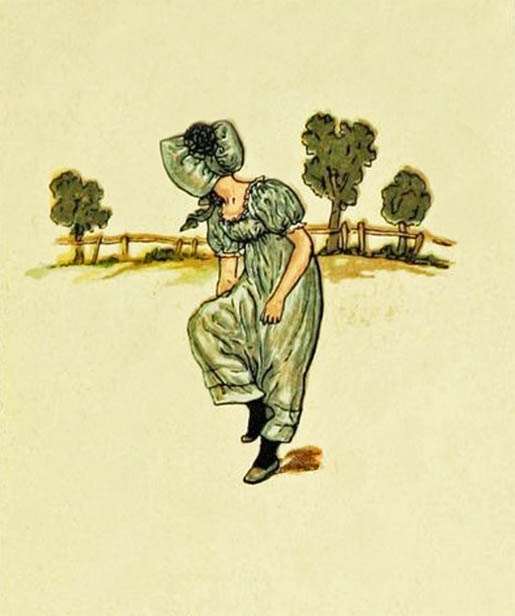
You’ll find Little Betty Blue in Kate Greenaway’s Mother Goose (1881), where she drew a girl standing on one leg in a meadow — exactly the scene your image shows. The rhyme was already circulating by that time, and later editions like The Real Mother Goose (1916) reprinted it with slight variants.
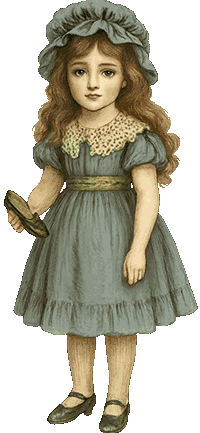 Greenaway’s collection is often taken as a benchmark for Victorian nursery canon. Because she included Little Betty Blue, the rhyme leaned into children’s books and art, rather than staying only in oral tradition.
Meaning
It’s not a riddle, though it plays lightly with logic. The “holiday shoe” suggests something special — maybe her best shoe, not everyday wear — which she loses. The rhyme’s “solution” is delightfully whimsical: give her another shoe to match, and she’ll “walk in two,” i.e. walk normally again.
It’s less moralizing and more playful. Children hearing it might smile at the silly solution, maybe even try matching shoes themselves in pretend play. The rhyme takes an everyday disaster (losing a shoe) and turns it into a small, poetic fix.
1. A simple retelling
Betty loses one of her special shoes, and the rhyme solves the problem by giving her another to match so she can walk properly again.
2. The characters
- Main character: Little Betty Blue
- Others: Not specified — only an unnamed voice offering the solution.
3. Setting
Not clearly stated, though often imagined outdoors or in a play setting.
4. Theme
A lighthearted look at small childhood mishaps and simple, whimsical solutions.
5. Moral
No direct moral — more playful than instructive.
