Humpty Dumpty Sat on a Wall
Humpty Dumpty sat on a wall,
Humpty Dumpty had a great fall.
All the king’s horses and all the king’s men
Couldn’t put Humpty together again.

The 1810 version:
Humpty Dumpty sat on a wall,
Humpty Dumpty had a great fall;
Threescore men and threescore more,
Cannot place Humpty Dumpty as he was before.
Humpty Dumpty as an Egg
The nursery rhyme Humpty Dumpty Sat on a Wall is probably one of the most well known in the entire English-speaking world. The 1810 version presented it as a riddle to which the answer was an egg. That's why even today the illustrations to this rhyme most often show an egg with a face, arms and legs sitting on the wall.
Initially, however, the nursery rhyme had nearly nothing to do with an egg. In the seventeenth century, “Humpty-dumpty” was a slang word for a short, fat and clumsy person—who indeed may have looked like an egg.
Humpty Dumpty as a Siege Tower
In August 1643, during the very first engagement of the English Civil War, the Royalists used a very poorly constructed siege tower to attack Gloucester which was then defended by the Parliamentary forces. The wooden tower fell over, and no matter how hard the soldiers tried, they couldn’t raise it again. The battle was eventually lost, and the siege tower was written (or rather sung at that time) into a mocking rhyme as Humpty Dumpty.
Humpty Dumpty in Wonderland
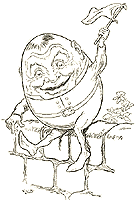 Later on, Lewis Caroll also wrote Humpty Dumpty into one of his books. This character appears in “Through the Looking-Glass”, which the sequel to “Alice's Adventures in Wonderland”. As was already the established tradition in the nineteenth century (the book was first published in 1871), Humpty Dumpty is an egg in the his book as well.

1. A simple retelling
A character named Humpty Dumpty sits on a wall, falls off, and cannot be fixed—no matter how much help is sent.
2. The characters
- Main character: Humpty Dumpty
- Others mentioned: The king’s horses and the king’s men
3. Setting
The rhyme doesn’t specify a place, but it implies a wall somewhere outdoors, possibly near a royal setting.
4. Theme
Once something is broken badly enough, it can’t always be put back as it was.
5. Moral
Possible lesson: Some mistakes can’t be undone — or no clear moral, just a memorable rhyme.
