There Was a Little Boy and a Little Girl
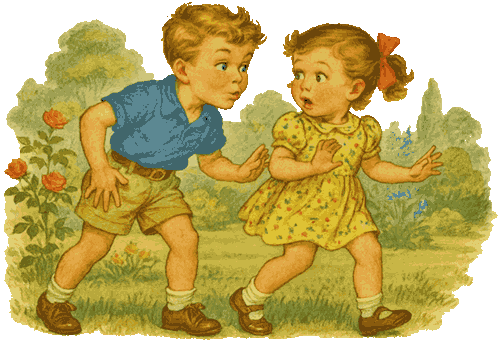
There was a little boy and a little girl
Lived in an alley;
Says the little boy to the little girl,
“Shall I, oh, shall I?”
Says the little girl to the little boy,
“What shall we do?”
Says the little boy to the little girl,
“I will kiss you!”
Origin
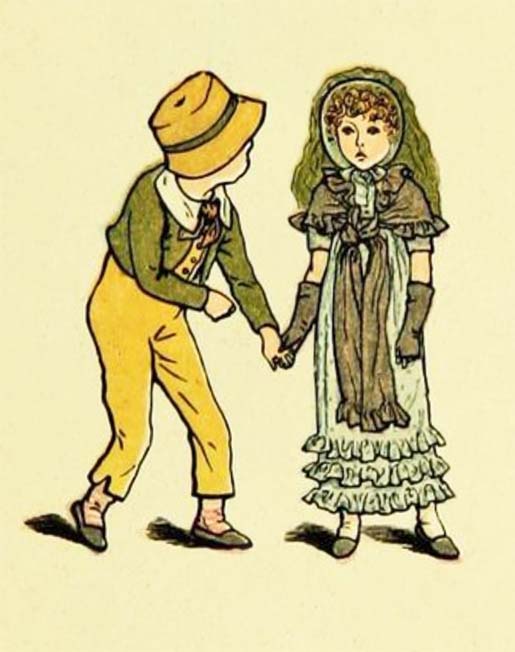
This short rhyme appears in Kate Greenaway’s Mother Goose; or, The Old Nursery Rhymes (1881), paired with her illustration of a boy and girl holding hands. Earlier versions can be found in James Orchard Halliwell’s The Nursery Rhymes of England (1840s), which shows that the verse was circulating in oral tradition well before Greenaway’s polished edition.
Meaning
This little verse isn’t a riddle or a lesson — it’s just a cheeky scene. A boy and a girl, tucked away in an alley, banter back and forth until the boy blurts out his answer: a kiss. The fun comes from how simple it is, almost like children acting out a play with only two lines each. The constant repetition — “says the little boy… says the little girl…” — gives it a sing-song rhythm that makes it easy to chant during play.
To adults in Victorian times, it may have looked like innocent flirtation dressed up as a nursery rhyme, but to children it was pure mischief — the kind of thing you might shout and then giggle about after.
The rhyme belongs to the tradition of mock courtship games in children’s lore. Like Georgie Porgie or Lucy Locket, it brings adult themes — romance, affection, even jealousy — into child-sized play. These verses were often used in group settings, chanted during skipping, clapping, or simple acting games.
By the time it reached Greenaway’s 1881 edition, the rhyme had become part of the Victorian nursery canon. Her graceful illustrations framed it not as rowdy street-play, but as a quaint vignette of childhood — ensuring its survival in print and memory.