Mary, Mary, Quite Contrary
Mary, Mary, quite contrary,
How does your garden grow?
With silver bells, and cockle shells,
And pretty maids all in a row.
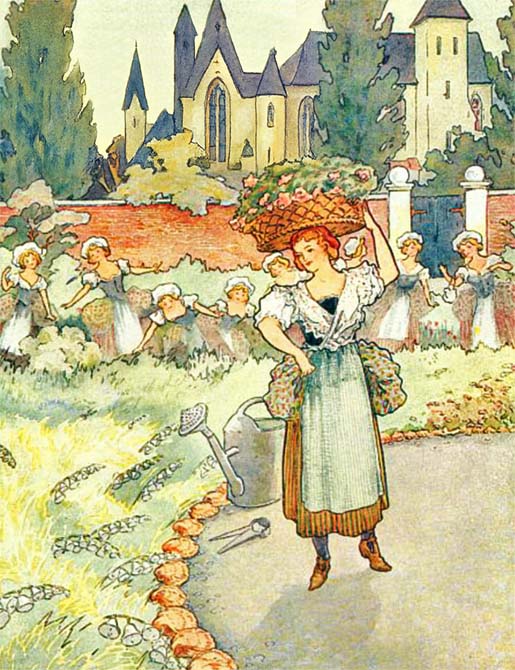
Some other versions for the last line are: “Cowslips all in a row”; “Marigolds all in a row”; “With lady bells all in a row”.
Queen Mary I
This nursery rhyme has several different interpretations. The most widespread explanation connects it with queen Mary I (1516-1558), who executed Protestants, filling cemeteries—called the “garden” in the rhyme. “Silver bells” and “cockle shells” are said to be instruments of torture, and “pretty maids” are supposed to be guillotines.
There is, however, a problem with this explanation. The version published in the year 1744 does not have “pretty maids”, and Mary is called a “mistress”:
Here’s the 1744 version:
Mistress Mary, Quite contrary,
How does your garden grow?
With Silver Bells, And Cockle Shells,
And so my garden grows.
Also, there is also no proof that the rhyme was known before the eighteenth century, which makes it somewhat hard to believe that it could originate from the sixteenth century.
Allegory of the Church
Another, a more probable interpretation, takes it as an allegory of the Catholic religion. Silver bells are the altar bells used at a Catholic Mass (they are used at the time when the priest celebrates the Eucharist); cockleshells are pilgrims’ badges; and pretty maids are Catholic nuns.
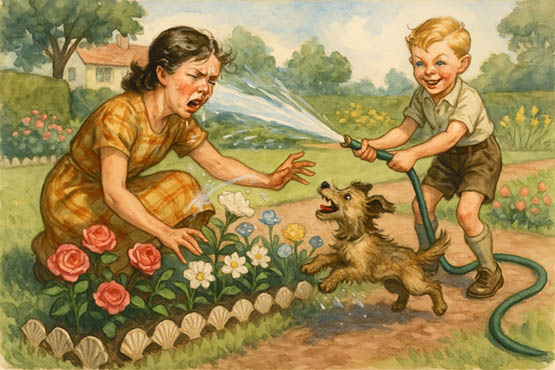
Every garden has weeds. Hers has a brother too.
1. A simple retelling
A girl named Mary is asked how her garden grows, and she answers with a list of unusual things like silver bells, shells, and rows of maids.
2. The characters
- Main character: Mary
- Other characters: Not specified
3. Setting
A garden
4. Theme
Theme: Mystery and symbolism
5. Moral
No clear lesson.